FYI, a confident answer can still be wrong.
A hallucination is generated content that is false or unsupported but presented as if it were established. Fluent wording, a confident tone, or a detailed explanation does not by itself verify the claim.
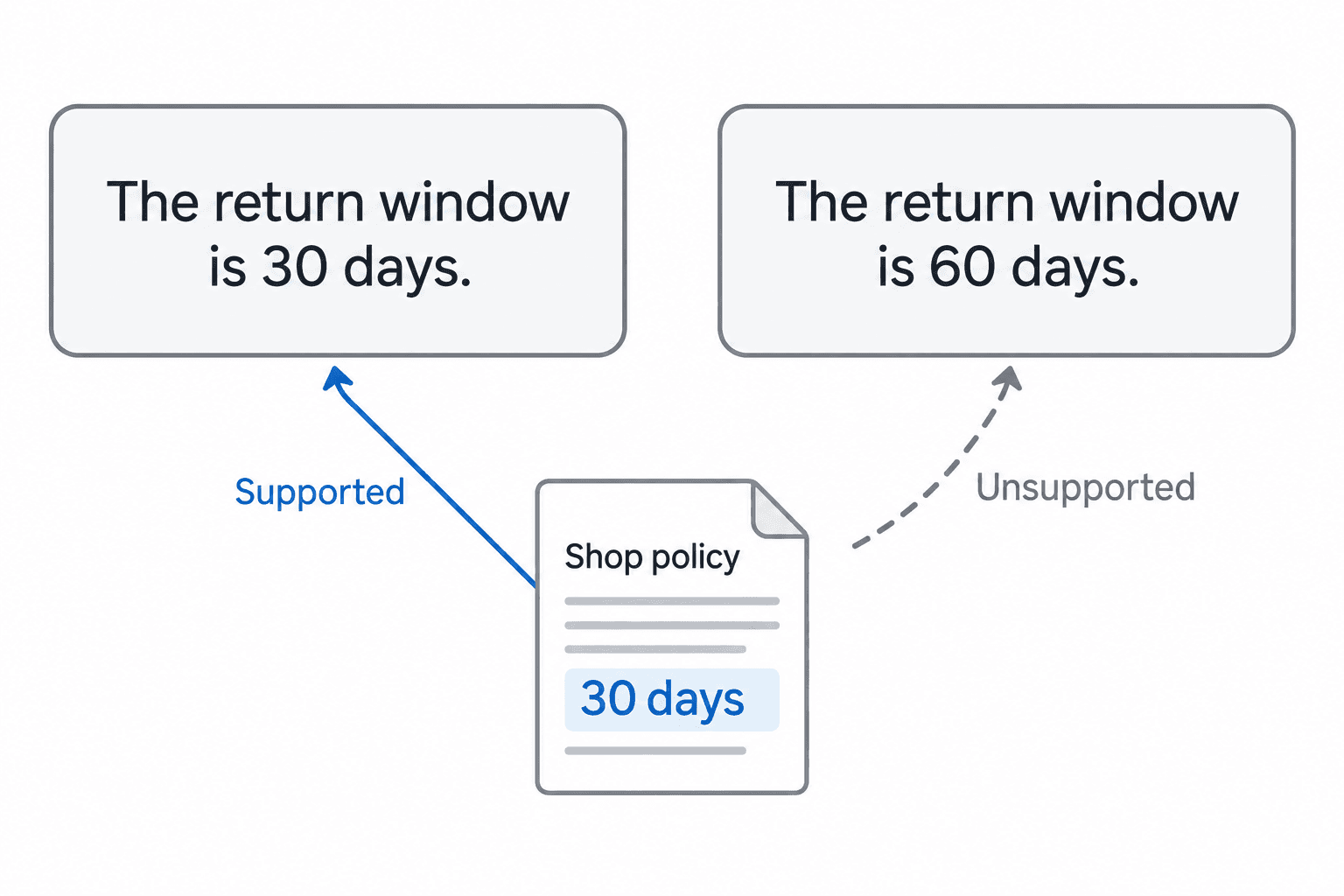
The tone is equally confident; the evidence is not. Compare the claim with its source. This simplified shop-policy example is fictional.
View diagramSee it happen
Both sound certain. Check what supports them.
These two made-up answers use the same confident tone. Which one matches our fictional shop policy?
“You have 30 days to return an unused item, with a receipt.”
“You have 60 days to return an unused item, with a receipt.”
Fluent wording is not evidence. In real use, verify important claims against a reliable, relevant source—and check that source too.
Scripted illustration, not a live AI result. Example details are fictional.
The tone can be right while the fact is wrong
Imagine a fictional restaurant answer: “Absolutely—there is a table for two at 7.” It is concise, specific, and reassuring. But if no availability was checked, those qualities do not establish that a table exists.
The same problem can appear as an invented opening time, a nonexistent source, or an accurate quotation attached to the wrong place. A small unsupported detail can sit inside an otherwise useful answer.
A common mix-up
“Hallucination” is a metaphor for an output problem, not a claim that a model is experiencing something. It also does not mean every incorrect answer has the same cause.
Asking “Are you sure?” may produce a correction, but it is not an independent check. A longer explanation is still generated content. Research on reasoning explanations also finds that they do not always faithfully describe the factors behind an answer; that is a separate reason not to treat an explanation as proof.
Why it matters
Match the check to the consequence. For dinner plans, open the booking result. For a quoted claim, read the cited passage and confirm it says what the answer says.
A helpful answer can separate what is supported, what is inferred, and what remains unknown. In the fictional example, “I found the restaurant, but have not confirmed a table” is less reassuring—and more informative—than unsupported certainty.